Friday, October 23, 2015

IVAN DOIG

Ivan Doig, maybe in the Seventies

Ivan Doig died early this morning.  He was my age.  Actually I'm four months younger.  The cause was "multiple myeloma" a blood plasma cancer that usually has a trajectory of eight years or so.  There is no cure.  It's one of those systemic breakdowns of check-and-balance body functions that often have their roots in childhood poor nutrition or hardship.  Certainly, Doig's childhood was WWII and not the easiest even in Portland where I was.  Ivan was growing up in marginal sheep-camps and ranches.  To accurately state he was a "ranch hand" one would have to add "teenaged."  He tells about the day he and his father narrowly averted a nearby buffalo jump becoming a sheep jump in a thunderstorm near Heart Butte.  According to him, he walked off the job and cut hay the rest of the summer.

Ivan and Jimmy Welch were about the same age, but Welch attended high school in Minneapolis.   He died of cancer several years ago.   Mary Clearman Blew was also born in 1939, but as far as I know, she's still kicking.  Like Ivan she also grew up on a ranch and they were good friends.  But Ivan was leery of Indians and never wrote about them.  Nevertheless, he wrote an anti-racism novel: "Prairie Nocturne,"   which went nowhere.


Ivan and I attended Northwestern University just north of Chicago and were probably in classes together but didn't know each other.  He earned a BS in journalism, went on to an MA there, and then took a Ph.D. in history at the University of Washington.  My step-daughter, whose father was Bob Scriver, was a year older than Ivan but also graduated from Valier High School.   Then immediately married.   Ivan said she seemed MUCH older and he was a little scared by her. When I graduated from NU, I came to teach in Browning.  People around here like knowing these sorts of timelines so they can fit themselves into them.

Ivan was the kind of willing and smart nerd that teachers love and was in many plays -- all that sort of thing.  I think he was boarding in Dupuyer part of that time.

Just now I went over and took a couple of photos of the school -- just completed in Ivan's day and not his fav kind of architecture.


They tell me his English teacher, who was one of those amazing intellectual women of the Fifties, lived in this house.  She had a lot of bookcases, the locals report.


Novels
  • The Sea Runners (1982) - an adventure novel about four Swedes escaping from New Archangel, today's Sitka, Alaska
  • English Creek (1984)
  • Dancing at the Rascal Fair (1987)
  • Ride with Me, Mariah Montana (1990)
  • Bucking the Sun (1996)
  • Mountain Time (1999)
  • Prairie Nocturne (2003)
  • The Whistling Season (2006)
  • The Eleventh Man (2008)
  • Work Song (2010)
  • The Bartender's Tale (2012)
  • Sweet Thunder (2013)
  • Last Bus to Wisdom (2015)
Nonfiction
  • News: A Consumer's Guide (1972) - a media textbook coauthored by Carol Doig
  • This House of Sky: Landscapes of a Western Mind (1979) - memoirs based on the author's life with his father and grandmother (nominated for National Book Award)
  • Heart Earth (1993) - memoirs based on his mother's letters to her brother Wally
  • Winter Brothers: A Season at the Edge of America (1980) - an essayistic dialog with James G. Swan
As editor
  • Streets We Have Come Down: Literature of the City (1975)
  • Utopian America: Dreams and Realities (1976)

This list doesn't include a research document available online at  http://www.fs.fed.us/pnw/about/early-research/earlyforestryresearcha.pdf.   One of his strengths was always research.  He tried to write about the PNW in "The Sea Runners" (1982) and "Winter Brothers" (1980) but they didn't sell as well as the very popular stories placed on the east slope of the Rockies.   "Prairie Nocturne" 2003 was about racism (a black man who sang opera -- not an Indian) and did not charm the locals.


"This House of Sky" is considered one of the ten best memoirs of the West.  It is the most passionate and maybe the most dark of his books.  Once he got started on a popular series, he followed his characters through several plots.  As a professional writer, he did an excellent job though a little too poetic for some people, and was able to make a living as a writer though his wife also taught journalism.  They were a tight team, gentle and thoughtful, but not particularly gregarious.  Funny and lovable, but not back-slappers and not part of the cliques.   Nevertheless, "This House of Sky" is the book that defines so-called Montana literature more than any other book.  They should all be so good and true.
Doig's parents, 1934


A TOWN MEETING IN DEADWOOD -- er, Valier


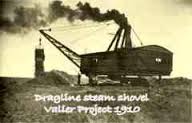
The mini-Bakken boom around here has changed the dynamics of Valier, adding itinerant oilfield labor to the demographics.  Once Swift Dam and the canal construction that is the heart of the town's economy had been completed in 1910, the previous boom dynamic of male gypsy labor moved on to other territory.  Cut Bank became the saloon town and petit professionals like school teachers did their relaxing in more upscale emporiums in Valier, places more like restaurants.  Froggies, which had been closed down, reopened as a pizza parlor with beer.  Since then, it has become more of a dive, though the parking lot fistfights have been kept to a minimum.


In fact, Froggies, its growing clientele, and the general weakness of the town council as they struggle with the fraying of infrastructure built a century ago and a constant stream of imposed requirements from the state, has meant that the malcontents and the mutineers have solidified into a kind of alternative political hub, though they have no background or information that is current.  Froggies is their headquarters.

This came to a head last night in a council meeting during which the Froggies crowd expressed huge outrage at the lack of respect for their fireworks event on the Fourth.  On the one hand the owner actually wept over the grievous insult of a town council member, gentle and quiet Dave Widhalm, coming into the bar and asking whether they had remembered to get insurance for the fireworks in a year so dry that in many places fireworks were flatly forbidden.  The indignation focused on Dave asking these questions in front of his clientele.  Also, this man felt that the posting of the Valier regulations for fireworks was an assault on his dignity.  He had a handful of notes detailing these failures of respect.  After a half-hour of being harangued, Dave humbly apologized.  I didn’t see why, though it was a generous thing to do.

In addition, the Froggie owner spoke out about the constant fury from people who want to do things that are blocked by city rules.  This news must be conveyed by city employees who are personally blamed.  

Then there was a diatribe over the failure to properly respect and support the older man who has volunteered to run the campground, so full on the Fourth this year that four spaces were double-camped.  He and his friends prepared the camp before the fireworks and then cleaned up afterwards -- all for no pay.  Among the other indignities, he has to go around to the camps to collect the fees because the town has not provided registration boxes the way the national parks do it.  
Valier fish cleaning station

One wonders at the enormous popularity of the campground this year.  This is the first year there has been a full-time resident camp tender.   One of the more peculiar complaints about the campground was that the very bright lights by the fish-cleaning station and the wash house should be turned off at night.  They were installed to deter persistent vandalism.

The campground (and the lake) is owned by the Pondera Canal Company and the head of THEIR board gave permission for the fireworks.  Again, rather strangely, no one seems to have consulted the fire department, though it’s only volunteer.  The Pondera Canal Company is a sort of “third government” of the town, but very quiet in most circumstances.  It is the whole reason for the town’s economic existence -- NOT tourists, nor fishing nor even ranches.  Froggie claims that the fireworks display was not advertising for his bar but rather a benefit event for the library (the most vibrant and irreproachable institution in town) and the VADC which springs into being whenever the ladies of the town want to undertake some improvements of a cosmetic nature. 

In fact, two ladies were there to propose more grant applications to improve the looks of the town, because surely money would follow if only the weeds were gone.  Of course, they propose to write the grants, as they have done before.  (The town can barely get the old ones paid off since they are usually partial funding.)  Many of the complaints by the Froggie crowd are demands for repairs to streets and so on that simply can’t be afforded without going into even more serious town debt which must be repaid by property taxes.  Maybe a third of the town is “owned” by Pondera County (the county -- not the Canal Company) because of unpaid taxes.  The county does not pay itself taxes.

Valier grain elevator

This is a collapsing town.  The grain elevator is old-fashioned and there is talk of abandoning it, esp. since the railroad spur may be closed down.  One grocery store is left and a proposition to sell it to someone younger has broken down.  The cafe has been sold to people who don’t have the vision of the previous owners.  The engine rebuilder of great talent is seriously ill.  The bank provides less and less service.  The owner of the Medicine River Trading Post is too ill to open.  One large and prosperous family, reaching critical mass, has bought the only service station (the other one closed) and the motel.  The car dealer is gone.  The other major business in town, a construction company, has an adjunct office in Kalispell and the company wives would rather live over there where there are many amenities.

Valier is less than a hundred miles from the Canadian border, next to the Blackfeet reservation, and on dealing terms with a half-dozen Hutterite colonies.  Our population is divvied up into compartments.  The whole situation is ideal for people who like to evade the law without attracting attention.

Lethbridge, pop 83,000, was originally Fort Whoop-Up, based on the whiskey trade (the Whoop-Up trail went past here), and after that a coal mining town.  It has always been a sin city with a veneer of upper class culture: universities, art galleries, and so on.  It is 131 miles from Valier.   Apart from the many 18-wheel haulers,  traffic up I-15 is fast, sporty cars with Canadian plates.  Great Falls’ population is not quite 60,000 with the same bourgeois cultural features (museums, universities, orchestra) but also Malmstrom Air Force Base.  It is 86 miles away.

Lethbridge, Alberta

When the cultured ladies who want to propose grant applications think about small towns, they do not think of the larger context or the opportunities for evading the law.  They do not think about the world wheat economy or the international corporations who own it.  They do not dream that a new water agreement with the Blackfeet tribe might very well cause ranches to fail, if the lack of snow pack in winter doesn’t end irrigation first.  They haven’t penciled on the back of napkin how many major construction projects on the northern prairie remain on the federal agenda, which have been what sustained the company.  Nor are they aware of how federal funds are steadily dwindling.


Their thinking is all on nice domestic terms, which is how they don’t notice the drug scene.  They drive up government costs simply by bustling around imposing surveys on people who never fill them out.  It’s not a glass wall that seals them off from the handsome, wolfish, money-making men or makes them the tools of the steak-eating, red-faced, heart-attack bait who hold office and run businesses.  It is a mirror.  But this has always been America’s problem.


I think that I will honor my grandmother, a staunch Women's Christian Temperance Union member in her prairie homestead years, by putting a referendum on the ballot this fall to make Valier a "dry" town.  Let the soreheads drink in Cut Bank.


BEAUTIFUL DOWNTOWN VALIER

Highway 44 thru town.

The reason I like reading about brain function and its evolution is that it’s so explanatory.  One thing it explains is that the brain sets up categories and interpretations of the forces it encounters and then refuses to give them up, even when facing facts.

Grain bins in town.

So people insist that Valier is a pretty little town in spite of the fact that some blocks consist of nothing but big metal grain bins, there is a feed lot next to the town limits (very well maintained, I must say), gray chemical fallow fields come right up to the town edge, and the worst “weed” in the mown yards is Roundup Ready alfalfa which comes back as soon as you cut it.  The older folks insist that other weeds be sprayed with Roundup and will not believe it is carcinogenic. (The same as they will not believe that a high sugar/flour diet will trigger diabetes.)  But then one of the complaints at the town council meeting was that the edge of someone's yard had been sprayed against their wishes, rendering it a brown dead strip.  As the complainant said, growing grass is a better deterrent to weeds than Roundup.  What no one said was that you can’t grow grass without water and our water is currently so expensive that only the prosperous can afford green lawns.

Chemical fallow, poisoned land.  The road is the town edge.

Logic has nothing to do with it.  Much of the agitation is driven by the high school fear that the other towns will look down on us, that they’re doing better and that somehow we aren’t trying.  Some of it is people blaming the town for their own aging and for the velocity of time-related change.  Our citizens don’t believe in global warming but if they did, they would be convinced it was the fault of the town council.  When you read what the VADC writes, they sound like advertising copy for a new dress shop.  “Unique, pretty.”  Many women here are in the habit of driving their husbands to try harder without much experience of the real world.


A big part of the problem is “outsiders”.  I’ve been here sixteen years and have spent half a century in the area, but I’m an outsider and will be until the day I die.  They say the only way to become an insider is to raise kids here all the way through to high school graduation, esp. if their year has good athletic teams.  Outsiders speak in terms of safety, raising kids, and Mayberry USA, which was about the past even in 1960 when it started being on television.  Most of our residents weren’t born yet in 1960.

Valier could be a “pretty town” if you only look at the parts where the more prosperous and employed people live.  Its streets are often empty most of the day.   It’s not as industrial as Shelby or Cut Bank where the tracks and transmission lines go off over the prairie in all directions and the smell of sour gas lingers.  Browning is considered ramshackle no matter how much one points out sculptures, shops and -- of course -- the hospital, museum, casino and rodeo grounds. But Valier will never be as historic as Fort Benton, never have as many interesting little shops as Choteau, and can never be a resort town like East or West Glacier, St. Marys or Babb.  No matter the fishing and boating, Lake Francis is always an irrigation impoundment -- not an alpine lake.

This was Ivan Doig's teacher's house, Currently for sale.

In the fifteen years (plus) that I’ve been here this time, maybe half the businesses have closed, but the real change has been in the morale of the town.  It has turned cross and intolerant.  Consider that Valier is the access town for Heart Butte and could double its customer base if it would kick the racism always simmering.   There are 698 people living there.  The estimated median household income in 2013 was $28,259, which is roughly twice mine.  The median resident age is 24.7 (one-third mine) while the Montana median age is 39.6 years.  Do people say life begins at forty nowadays?

One of the complaints has been the volatility of student numbers, but that doesn’t account for the fact that rez kids have the choice of Valier, Heart Butte or Browning and often move back and forth according to the gossip opinion of which is more effective, more fun, or more likely to have winning teams.  When kids realize how much power they have through simple attendance, they use it.

Heart Butte

It’s a strange thing to think that Swift Dam, the source of water for the Pondera Canal Company is on the rez above Heart Butte (which meant HB was devastated in 1964 when the dam broke) but the 1910 boom caused by building it was in Valier, just OFF the rez.  Of course, that’s where the irrigation water went, too.

But let’s leave all this for now and think about how Valier might reshape itself for preservation in the future.  I’m not talking about the kind of Sim City  ("simulated") little “improvements” always suggested after busy note takers come around to claim they represent everyone when they don’t even represent the double-dozen people who show up as Seniors for lunch in the town hall or who appreciate Meals on Wheels.


It’s obvious that racism just has to go, though it’s a national problem, like the constant polarizing that can turn into riots between blue and red interests or black and white populations.  We’re small enough to go against the tide.  If we were more activist on the state level we might even be able to head off the forces always trying to force us to do our shopping in Great Falls.  I’m talking about the distributors who refuse to deliver bread and fresh vegetables, who make rules supposed to be about health but really about monopolies (no home-based bakeries) and tending to close down small town grocery stores.

It’s beyond me why missionaries from Georgia are necessary to keep kids busy in summer and teach them their own heritage.  The same in Browning, though it’s more obvious there that the missionaries are enjoying a subsidized adventure in an exotic place.

This is the grizz family just captured on Lake Francis and moved.

Too much underground stuff goes on.  I did not know until I tapped into gossip that there has been a problem with teens swiping coolers from the campground in hopes they hold beer.  I made a swing past the campground last night and saw that it was empty.  Maybe it was just the capture of grizzlies at the edge of the lake.  I did not know that one reason for the bright campground lights is that there are night fishermen who are NOT grizzlies and the diligent use of the cleaning station is to keep fish guts from becoming bear beacons.

Already this town has a number of excellent craftsmen.  The library is booming.  Valier is part of the mystique of “This House of Sky” and Ivan Doig’s nationally beloved books about this area.  It is so strange and self-defeating to say the resentful things that one can overhear people express:  “Doig never did anything for us.”  “Libraries aren’t meant for kids.”  What is going on in their heads that they need these defenses?

If you ask, what you get is a long list of complaints.  If you interrupt the list, they will immediately go back to the beginning as though it were written down or recorded -- often repeating word-for-word.  They cannot take in new information or consider alternatives.  This is a brain adaptation to homestead life where there was no alternative to breaking ground and harvesting -- grueling, painful work that might not end in profit, driven by sheer determination and focus.  The only path to success was repetition, unvarying.

Library art project done by kids.


But in today’s world, the way to succeed is variable, inventiveness, asking the big deep questions.  How can we become stable without becoming paralyzed?  I think it is by trusting each other enough to tell the truth and work together.

THE TREE AND THE BUCKET TRUCK


If you look for my house on a satellite feed, all you’ll see is trees.  You can spot the Southern Baptist Church next door because they cut down all their trees and wanted to cut mine, too -- that is, the ones on the property line.  Zillow claims my house is worth $125,000 which is laughable.  The county taxes me for $40,000;  I paid $30,000.   What I have learned about old houses is that you will need an equal amount after buying the house because so much maintenance has usually been deferred.  They’ve often been granny houses or rentals.

The north side of the house is full of trees, volunteer poplars that I like to call “populars.”  They aren’t big around but there are quite a few of them and they crowd up against the house.  Lately one has grown a branch over that lies on the old original cedar shakes and when the wind blows that branch beats and pries.  It’s a little bit too high up for me to get it with a ladder.  If the shakes are stepped on, they split.  Also, they are VERY slippery.


The south side of the house has the big cottonwood that is so important to me and that the minister from back East wanted to cut.  It’s a silverleaf cottonwood.  There are a lot of them throughout small Montana towns, brought in by some ambitious person from their home ecology, which is down in coulees along creeks.  On this dry windy prairie they are always a little stressed, especially if not regularly watered.   The high parts die easily, pronging into the sky and tempting the lightning.  If they are cut down or fall down, they will grow a new trunk or rather multiple trunks.  I suspect that a tree expert would know what year that fellow selling trees came through, because most of them are about at their growth limit.  My guess is that it was in the boom after WWI.

My populars are much smaller trees, in a grove that planted itself.  In fact, if I let the volunteer starts of both species just grow, I would be in a jungle.  I knew I had to somehow get rid of that branch that thinks my house is a drum.  But I didn’t know how much it would cost and at 76 I don’t handle heights well anymore.  (I’m also at about my growth limit.)

I was reading the newspaper -- I get to it late in the afternoon  after my blog is written -- when I slowly realized that what I had thought was a weed eater was actually a snarling chain saw.  Quickly I scrabbled around for outdoor shoes and straw hat, piled into the pickup and began to search the streets of Valier.  I figured someone was limbing trees and they might be willing to swing by to deal with that destructive branch.  Too late.  Only a neat pile of sawed branches.  At least they had done a respectable job.  Some people confuse trimming with assassination.  Control over a living thing!  Bwaaaahaaaahaaa!!

In a day or two I heard the saw again, or maybe I didn’t.  I couldn’t find any crew.  Finally I found a woman who had gotten some work done.  She couldn’t remember the name of the outfit or the phone number, but she had contacted them by putting a sticky note on their parked bucket truck.  And she was pretty sure they were going to a place next that was only a couple of miles out of town.  They were, I found them, and they soon drove up.  In fifteen minutes the offending branch -- plus a few others that had died in last winter’s lethal weather were on the ground.   

The arborists were two young men from Missoula, each with a fairly new powerful truck, sharing a red Australian heeler dog named for a Norse warrior (“Thor,” I think.) but as benign as he was muscled.  Sort of like Brad Pitt. The truck license numbers began with “4” which is Missoula and below is their flyer.  The phone number is their “mission central” where they check in for assignments.  Whoever made the flyer evidently had the idea that a bonsai might need trimming, and I suppose they do, but it’s not necessary to have a bucket truck or a chain saw.  Manicure scissors will do.  If you fail to write down the contact number, they show up all over Google and even Facebook.


The bucket truck has been parked in front of my house overnight while they go back to their motel.  They quietly drove off a while ago.  I’ve begun to wish I had a bucket truck.  Think of being able to go high to take photos or pick kittens out of trees.  I didn’t interview these guys much and now I have mixed feelings.  I’d like to know more about them but I sort of like the mystery.  It’s a summer tale.


Maybe I’ll invent a story: two brothers inherit a bucket truck and take off across the continent.  It would be a road trip that includes a lot of stuff about the geography of trees, species distribution and the practice of prairie vegetal architecture: shelter belts, wood lots, homestead groves, erosion control, pheasant and deer habitat.  You could make it sinister if the guys compete for a woman they meet and one sabotages the bucket.  But maybe it would be better to play it romantic and describe making love in the bucket.  Sort of like Canadians making love in a canoe.  Carefully.


Back to reality: I have a pile of gnarly branches in the back yard that I’ll gradually break down and burn on rainy mornings, which do come in summer, interrupting the heat briefly.  High prairie mixes its seasons.  At the moment we have one of those arctic intrusions that are deadly in winter.  I had to put my extra comforter back on the bed.  But fifty degrees is pleasant sleeping weather.


And it makes me sleep a lot better to know there’s not a tree knocking on my roof, wanting to get in.


TOWN COUNCIL A Rainy Night on the Prairie


Entering Valier

The Town Council meeting last night was immediately preceded by a preliminary Valier Local Government Study Commission. It’s supposed to determine which of three “forms of government” the town would like. Presently it’s “Commission Executive.” (Four commissioners and a voteless mayor who manages.) The main change recommended was merging the town’s two wards into one, since the population is shrinking, it becomes ever harder to find people to serve as commissioners, and the whole town is fairly mixed as to prosperity, history, desires, and so on. (75.9% in favor when surveyed.) There was strong support for keeping the nonpartisan elections (93.7%) which is in line with the county and also previous practice. People want their elected officials to get training for the very complex and layered issues and therefore an ordinance is recommended requiring that all elected officials attend classes.

That’s the official story. Unofficially, on the level of gossip, three prominent citizens are moving away: one for a bad reason, being caught in an FBI pedophile sting; one for a neutral reason, moving to be closer to work; and one because of increasing discomfort, partly caused by drifters. Her house is in an area where floaters tend to try to squat, between a drinking establishment and blocks of wheat bins once owned by the government and now clustered on the land of one individual but owned by various grain farmers who separately own the bins according to their needs — some only one, and some more. There are no alarms or lights and poison use is liberal in order to eliminate vermin. In such a shielded but easily accessed place near the highway, it’s not hard to imagine “poisons” in the form of drug sales to finance adventures.

A Memoir about Valier, MT. and the east slope of the Rockies

In the beginning I only idly wanted to write about Valier, but was a little wary. The town is hostile to Ivan Doig, whose memoir “This House of Sky” is one of the “ten best” on lists of literary scholars and popular readers in other places. This is a strange phenomenon that’s also true of James Welch, Jr. on the Blackfeet rez and was true of Wallace Stegner in Eastend, Saskatchewan, until they realized they could make money from his reputation. (The book is “Wolf Willow: A History, a Story, and a Memory of the Last Plains Frontier.” (1962), in which the town is called “White Mud,” because of a deposit of white clay quite famous for its use in porcelain.

Stegner’s boyhood was just north of here on both sides of the 49th parallel.

Both Doig and Stegner wrote the same story again and again, Doig drifting towards a popular and sentimental fiction style; Stegner becoming more essayist, environmentalist, and universal. Welch was far more inclined to try new subjects, but his readers didn’t like it. Readers, or at least publishers’ understanding of them, are highly conservative and resist anything new or different. “The Indian Lawyer” (1990) offered insight into what he’d learned on the Montana parole board and “The Heartsong of Charging Elk” (2000) explored the French love of Native Americans, but readers cling to “Fools Crow” (1986), a traditional 19th century tale. It remains to be seen whether “Winter in the Blood” (1974) will be read on account of the movie version.


This is a traditional “feathers and horses” story with a strong moral spine.

These three writers are all dead and their books are decades old. Have the rules changed enough to allow writing about Valier? One woman leaned into my face and spat, “If you EVER write about me or my family, I will KILL you!” Why so emphatic? What’s at stake? Nothing less than survival, which they are convinced depends upon reputation. They believe a reputation is something that can be controlled. If you watch Masterpiece Theatre very much, you’ll soon acquire this mindset. It is a Brit bourgeois understanding of culture, dependent on prosperity.

When one drives through Valier, many of the houses and yards seem bright and tended, esp. if one doesn’t go up and down all the streets. Darrell Kipp, when he went through Valier on the way to the Great Falls airport, used to drive up and down all the streets, trying to understand White Town. It remained a mystery to a boy who grew up in Blackfoot, for a long time the terminus of the Great Northern Railroad, so a concentration point for writers and anthropologists, people who wanted to drive up and down the rez. As an adult, Darrell’s house was more elegant inside — good furniture, fine paintings — than most in Valier. The yard was shaping up. It’s yards that obsess Valier — they don’t necessarily want fences, but they want lawns and landscaping as indicators of propriety.

Someone in our quiet little conversation last night said they had noticed that the people who were constantly besieging the town council with complaints and demands tended to have moved to town about the same time I did — 1999. I suppose it was a recession, but I lose track since there is always a succession of recessions. There’s supposed to be a study somewhere. I came from the city, but these tended to be retirees moving in off the ranches and farms that were formed in their youth. Or industrialization in the form of giant machines made their homesteads redundant. Some of the houses followed the people into town.

As the oil industry shrinks and reshapes itself, responding to the world economy and to earthquakes caused by frakking (there was one, very small, north of here a few weeks ago), the Hutterite boys who went to make their fortune on the Bakken are likely to be filtering home, quite changed. What will that do? The Hutterite communities are more involved in Valier than the town thinks. Their schools are managed by ours.

When I inquired about the town’s archives, I was told that most of them have been shifted to Helena. I wonder how much care has been taken of what must seem insignificant to them. But some boxes remained here and among them might be a very interesting period during which Valier was technically not a town because the state had required something the town didn’t supply. They managed to regain their status.

The webwork that ties this town into a potential book is a kind of vascular system of irrigation with its head in the Rocky Mountains where the snowload diminishes yearly. The end is not here in town, but far away by railroad and ship until it reaches nations that the US can control by bargaining with its vast store of grain, more powerful than the threat of bombs, more powerful even than bargaining based on response to disease. Famine is the ultimate, most ancient, killer.

Grain storage bins right in town.

This isn’t just a little town that’s always in the throes of family feuds or mercantile arrogance or entangling fees and regulations. It is a source of life-blood that we are beginning to understand is threatened by experimental grain seeds, climate change, political gridlock at every level, and the constant hydraulic-like pressure of diseases on plants, animals and people, some — like pesticides — ironically turning against our families with cancer and miscarriage. The planet is a sheet of relationships looped together like the fragile fabric of sheer stockings, easily rent and "run" into what the Brits call “ladders.” Going down.

There’s a Finnish man old enough and big enough that he can speak the truth. Last night he was frank: we are all at stake, but only a few will address the problems. They ride on the efforts of others and don’t even admit it. How can they NOT know what is at stake? Their own lives.

TIME-LINE FOR THE TOWN OF VALIEER

Time has moved on.

I think I will begin this project, which will take a long time, by going forward in plain sight as I have done with the Blackfeet materials.  As an ordering mechanism, I’ll include as many links as I come across.  Some materials will make people uncomfortable.  Others are simply explanatory or interesting, with a few surprises.  If there is misinterpretation I take responsibility and will make corrections as far as possible.

Reroofing the old Belgian church

“Williams” is a community that existed only as an enclave for the Belgian immigrants when they first arrived and now marks the location of their Belgian language church, just below "Belgian Hill" where an array of antennas and relays are lined up.  The history of Belgium comes into the story in several ways.  It is a plural composite nation unified by language, which made a Belgian language Catholic church very important.  But as the children grew up speaking English (or American, actually) the need for the church and the community lessened to the point of making Williams a ghost town.  But the popularity of genealogical research has brought memories of Williams to the surface.  And the graveyard is still a home ground.

Interior

The other more “colorful” nearby temporary community was Robaire on Birch Creek.  It was created when the supervision of the Blackfeet Reservation was allotted to the Methodist denomination as a corrective against corruption.   The Jesuits had been active for a long time and claimed most loyalties. The new Methodist agent, connected to the anti-Papist sentiments that clung until JFK was elected president, banned the Catholics.  Methodists are “dry” -- forbidding alcohol -- so that was also a new policy.  Robaire was the response of the ousted, just across Birch Creek from the rez jurisdiction, near the present route of Highway 89.  They say the bar was next to the new little Catholic chapel.  Anyway, Birch Creek claimed the remnants of Robaire in the 1964 flood.


Gene Curry

The flood also overwhelmed Swift Dam, killing dozens of Blackfeet when a wall of water swept down Birch Creek.  The Carey Act came back into the news recently when the Curry family sued over the proper entitlement to irrigation water.  The government’s role in creating and defending land and water entitlement-based sources of wealth is now a lively source of income for lawyers.  Again the stream itself plays its part: diminished snow pack (whatever the cause) means less water for the new negotiations over water rights.  This time the Blackfeet are active negotiators.

VALIER TIME LINE (Just beginning to develop)

1910 is the end of the Edwardian Era --King Edward VII (Queen Victoria’s son and heir) died that year.  (So did William James, and Florence Nightingale.)  Some people say that the 19th century didn’t end until the beginning of WWI.  Science and inventions were just becoming “industrial.”  Empires were weakening.  Natural resources were in major demand.  The end of the War Between the States had major consequences across America.


Charles Conrad's home in Kalispell

1886  W.G. Conrad and bro Charles of Kalispell took up eleven sections of land but didn’t develop them until 1889 when they left Fort Benton.  Their cowboy employees were guided to “homestead” and then sell their “proved up” land to the Conrads.  

Major Steele, then the Indian agent and married to a Blackfeet woman, sold their ranch to the Conrads.  It was a narrow place, the natural locus of Swift Dam.

1894  The Carey Irrigation Land Act, was a way to acquire land by irrigating.  Others did this as well.  The following is reblogged from an Idaho history blog called “Revue Guru” that traces out a situation that was repeated in Montana.  Link to the blog is at the end of the quoted post below.


TUESDAY, AUGUST 18, 2015

Desert Land (Carey) Act Signed to Encourage Irrigation in the West

On August 18, 1894, President Grover Cleveland signed the Desert Land Act of 1894, better known as the Carey Act. Sponsored by Wyoming Senator Joseph M. Carey, the Act was meant to improve the success rate for the settlement of the public lands. The law specifically addressed the millions upon millions of acres in the western states that required irrigation for productive farming – the so-called “arid lands.”

Individuals and irrigation cooperatives had already exploited most of the land that could be watered with smaller systems of canals and impoundments. Many larger projects funded by farmer cooperatives or hopeful investment firms had failed, and discouraged further risk-taking on that scale.

The Act authorized the Federal Land Office to transfer up to a million acres of arid public lands to individual states that established approved reclamation programs. States would cover expenses by charging fees and selling the land at nominal prices, with the real incentive being the expected increase in tax revenue.

Acceptable state programs would be able to certify acreage as meeting the requirements of the Act, inspect and approve irrigation projects executed by private investment firms, and oversee the ultimate transfer of properly-irrigated 160-acre plots to individual settlers.

Development companies proposed, designed, and built suitable irrigation projects. They profited by selling water to the settlers, at rates determined in negotiations with the state reclamation office. The development company did not “own” the land itself – technically. However, these firms could place liens on the land and the associated water rights to protect their capital investments … so the effect was basically the same.

Settlers usually paid a flat entry fee ($1 in Idaho) and an almost trivial cost per acre. Owners had to then dig a feeder ditch to connect with the nearest main canal. Once water became available, they followed a schedule for bringing a set minimum of their holdings into cultivation. In three years, if they met all criteria – including construction of a “habitable dwelling” on the property – they received title to the land.

Of course, developers seldom waited out the years it might take before cumulative water sales covered their large initial investments. Once settlers held much of the land, an operating canal company or joint water district bought the system and the collective water rights from the developer. 


Milner Dam, 1905. 
One of the first Carey Act projects in Idaho.


The Idaho legislature quickly established the position of State Engineer and tried to assemble the administrative infrastructure to support Carey Act projects. A few years passed before the state refined the process, but then interest picked up substantially. Thus, in the first ten years after passage of the Act, Idaho developers started just 10 or 11 projects. Then, in 1905-1907, they added 14 new ones.

The emergence of so many new projects led Congress to add another million acres to Idaho’s allotment in May 1908. Two days after that authorization, they added yet another millions acres, while also increasing Wyoming’s allotment by a million.

With that much land available, development exploded: In 1908 through 1910, developers initiated forty new Carey Act project in Idaho. No other state approaches Idaho in the exploitation of the Carey Act and later related legislation. By one reckoning, 60% of all U.S. acreage irrigated by Carey Act projects is in Idaho.
                                                                                                                                      

References: [French], [Hawley]
“Canals & Irrigation,” Digital Atlas of Idaho, Idaho State University.
The Cary Act in Idaho, Idaho State Historical Society (2004).
 “Carey Act of of August 18, 1894 (28 Stat. 422),” Code of Federal Regulations, U. S. Government Printing Office, Washington, D.C. (2012).


190?  M.S. Darling, engineer, constructed a ditch system of 50 miles that diverted both Birch and Dupuyer Creeks. Conrad brothers also organized the Pondera Canal Company 

1907  2 feet of snow with crust that would support a horse.  When broken through, this crust became a knife that cut their legs.  This probably prompted the end of cattle ranching on open range.  Even cutting hay had not prevented major losses.

1908  Cargill bought the land, livestock and water rights of Conrads.  Carey Land Act Irrigation project.  They laid out plans for town of 3,000 next to Lake Francis.

1909  Substantial 3 story stone and brick hotel built
1909  Harry P. Harrington’s jewelry store opened.
1909   Dr. G.D. Powell came as the second doc and stayed until his death in Nov.1943.   No resident doc after that.
1910-11 First water system
1912   First electricity -- a steam generator plant.
           Montana power replaced them.
1912   Dr. G.F. Tidyman was the third doctor and retired in the late twenties.


2-6-1913  Monsignor Victor Day, a native Belgian priest, brought over 80 in 13 families from Belgium and Holland.  Left Antwerp on the S.S. Vanderland.
Later in 1913 Goemare Christiaens, with the help of Father Day, went back to Belgium and brought a second group including Pharila Sabbe whom he married and Peter Habets family, Pharila’s birth family.

Goemare Christiaens says,  “I took part in this colony and have now returned to Belgium with the aim of getting more settlers together, in order to enlarge the existing colony. This colony went to Montana under the guidance of Monsignor Victor de Brabandere of Desselghem, now living in Helena, capitol of Montana. The colony consists of the following families: 
The three families Christiaens originated in Waereghem 
The family Jules Sabbe from Waereghem
The family Henri Deketele from Nazareth
The family Cyrille Ghekiere from Beveren (Leie)
The family P. Leclerq , Bachte (0. Vl.)
The family H. Vandoorne, from Denterghem
The family C. Vandebulcke-Nollet from Noordschote
The family Th. Beelaert from Meulebeke
Emile Verstraete from Meulebeke
Cyrille Decramer from Langemarck
Maurice Tack from Caeneghem
Ch. Vanderjeught from Dendemonde (O.Vl.)
Rene Vandepopuliere from Moen
Remi Nollet from Noordechote 

The families Habets, Jochems, Houbens, Raemaeker, originating in Holland.

1913  https://diosav.org/sites/all/files/archives/A%2007-24-14%20CROSS%2007.pdf

Newspaper article.

QUOTE:"When Sister M. Lillian Quadrella, RSM, donated a small book that originated in the Catholic Diocese of Helena, Montana to the Archives of the Diocese of Savannah, there was – as often happens – some mystery connected with it. Dubbed “First Communion Catechism”, the book was adapted for the Helena Diocese by Victor Day, modestly identified as “A Priest of the Diocese of Helena”. Written for the benefit of Sisters who’d teach from it, the book complied with a paper pre- sented at the 8th Annual Institute of the Catholic Educational Association in 1913. Comprised of 35 questions and answers culled from the Baltimore Catechism, the book bore the imprimatur of Bishop John Patrick Carroll and a 1917 copyright. "

Monsignor Victor Day in action